
Table for one: solo dining is growing, but barely shows in the reservation book
It's seven o'clock on a Monday morning. At the restaurants that serve breakfast, often hotel dining rooms, the day's first guests are starting to trickle in. Many of them come alone. At this hour, more than one in three parties in our data is a single person: the business traveller with the laptop bag, the coffee and fifteen minutes until the first meeting.
Solo diners are one of the industry's fastest-growing guest groups, and they hardly ever show up in the reservation list. Guestrix follows both booked tables and walk-in guests at restaurants across Sweden. When we put the two channels side by side, the solo diner comes into view: spontaneous, weekday-bound and increasingly common.
We produced the figures in this article for Svenska Dagbladet, which covered the trend in the article ”Det är lyx att gå ut och äta ensam” (“It's a luxury to go out and eat alone”, in Swedish). Here is the full dataset.
The guest who doesn't book
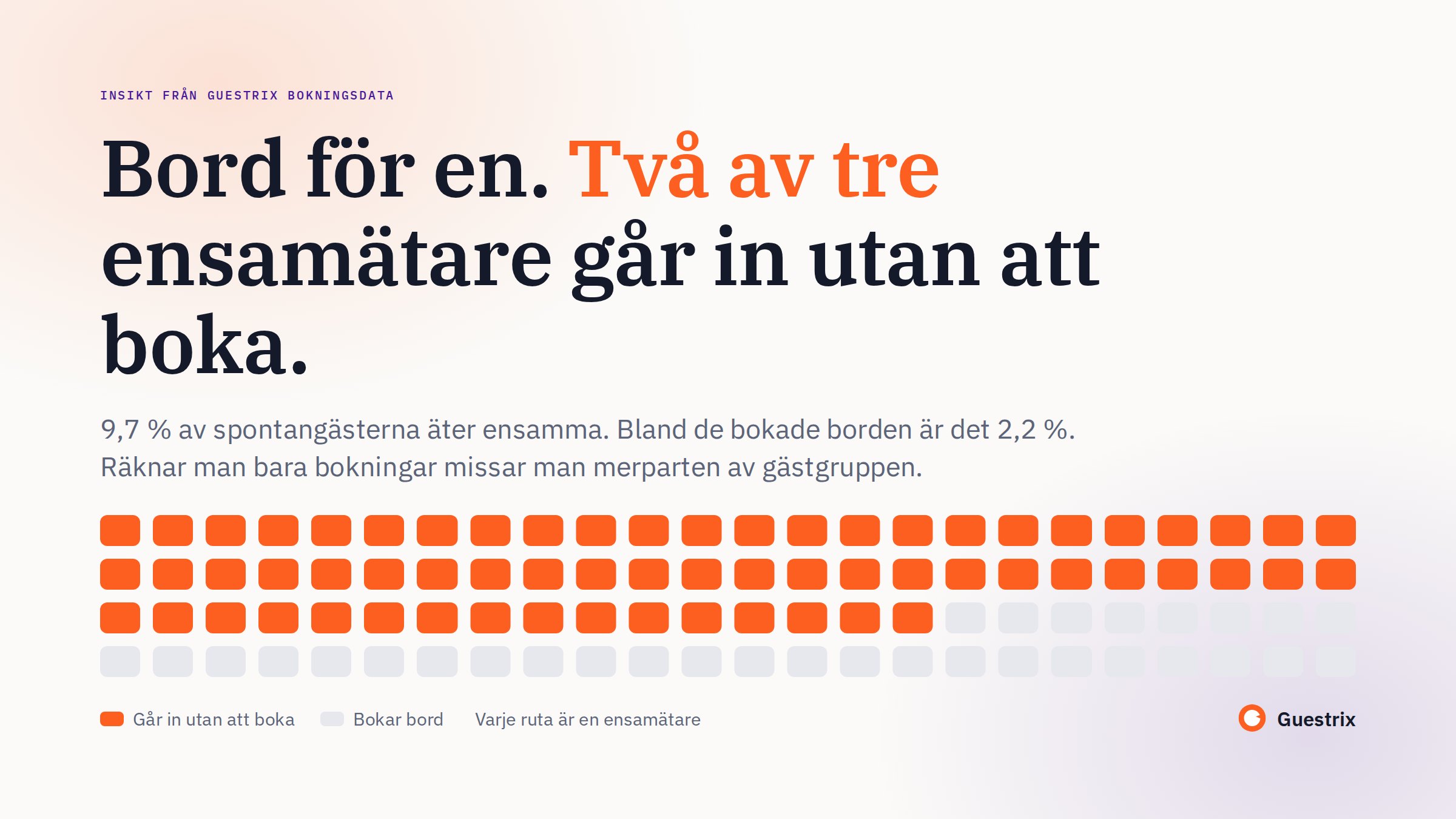
If you want to understand solo diners, don't start with the bookings. Today 9.7 per cent of walk-in guests eat alone, counting all restaurants with data right now. Among booked tables, only 2.2 per cent are a party of one. So roughly two thirds of solo diners walk in without a booking. Count only reservations and you miss most of the picture.
And when they do book, they do it at the last minute: a median of 15 hours before the visit, against 75 hours for larger parties. Solo diners are the restaurant's most spontaneous guests. They decide the same evening, not the same week.
The trend shows in both channels
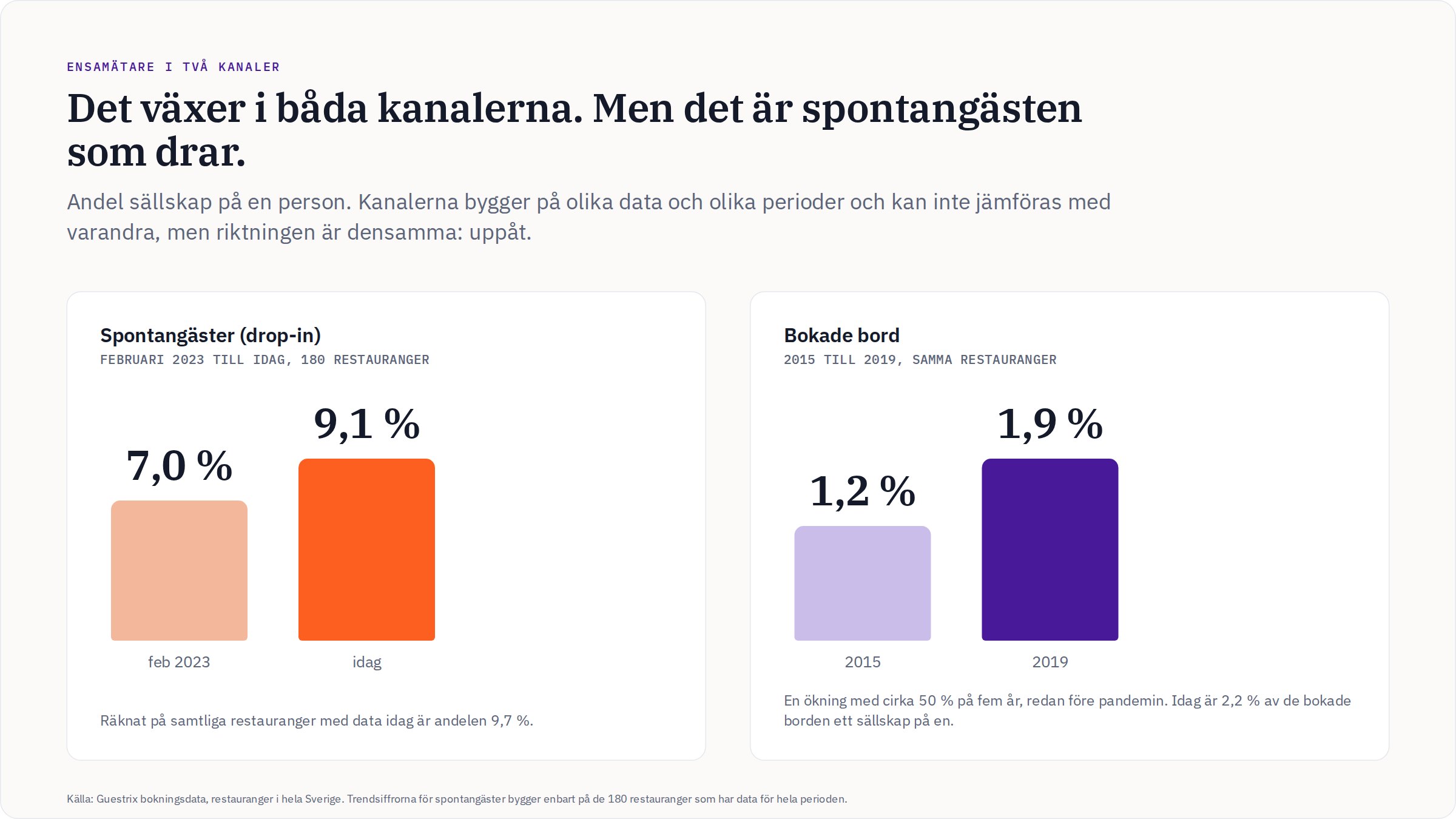
The phenomenon isn't entirely new. Among walk-in guests, the share of solo diners has risen from 7.0 to 9.1 per cent since February 2023, measured only at the 180 restaurants with data for the whole period. That is why the figure differs from today's 9.7 per cent, which is calculated across all restaurants with data.
The direction was visible before the pandemic, too. In bookings at the same restaurants, the share of solo bookings rose from 1.2 to 1.9 per cent between 2015 and 2019. That's an increase of around 50 per cent in five years.
Monday at seven, not Saturday at six
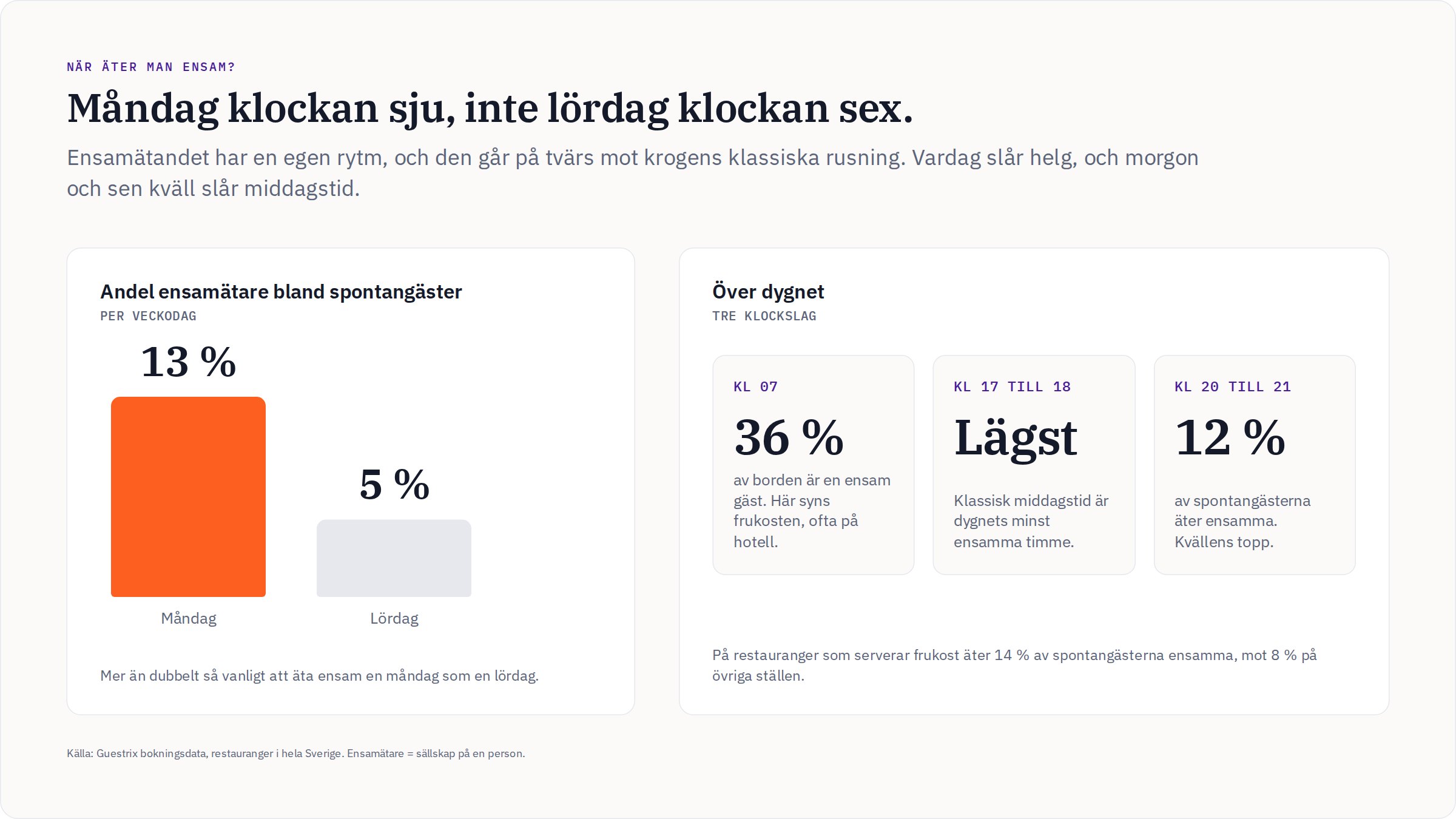
Solo dining has its own rhythm, and it runs against the restaurant's classic rush. The share of solo diners among walk-in guests is more than twice as high on a Monday (13 per cent) as on a Saturday (5 per cent). Weekdays are well ahead of the weekend.
The pattern is clearest where breakfast is served. At restaurants serving breakfast, often hotels, 14 per cent of walk-in guests eat alone, against 8 per cent elsewhere. Among their booked tables, 11 per cent are solo bookings, against around 2 per cent in the rest of the industry. That's the business traveller showing up in the numbers.
Otherwise, the restaurant's profile matters surprisingly little. Lunch spots, evening restaurants and mixed operations sit close together, between 8.7 and 9.3 per cent among walk-in guests. The difference isn't whether a restaurant lives off lunch or dinner, but breakfast and the time of day.
- Early morning: at 7 am, a solo guest sits at 36 per cent of tables.
- Late evening: among walk-in guests, 8 to 9 pm peaks at around 12 per cent.
- Lowest is the classic dinner hour, 5 to 6 pm.
The phenomenon is also concentrated: 100 restaurants account for half of all solo-diner tables.
Where is it heading?
Most signs point to solo dining continuing to grow, in the form of more spontaneous visits rather than more bookings for one. The growth is among walk-in guests, while booked tables are increasingly driven by groups.
"We see the solo diner clearly, but mostly among the guests who don't book: just under 10 per cent of all walk-in guests eat alone, against just over 2 per cent of booked tables. Roughly two in three solo diners walk in without booking." – Linus Lennstrand, Guestrix
What does it mean for the restaurant?
You don't capture the solo guest with “table for 1” in the booking system. You capture them at the door. Three things to look at in your own data:
- Keep seats unbooked. A bar counter and a few small tables held back from bookings are what let the walk-in guest find a seat on a Monday evening.
- Look at weekday mornings and late evenings. That's where the solo diner is, not in the Saturday rush. Staffing and menu at 7 am and at 8 to 9 pm may look different from 6 pm.
- Count walk-in guests, not just bookings. If you only follow the reservation book, you see a third of this guest group. In Guestrix, bookings and walk-in guests sit side by side, per day and per hour.
About the data
Source: Guestrix booking data from WaiterAid and BokaBord. A party of one counts as a solo diner. Bookings and walk-in guests are always reported separately, since the channels are based on different data, and they are never combined. Walk-in data is available from February 2023. Trend figures such as 7.0 to 9.1 per cent are based solely on the 180 restaurants with data for the whole period, while level figures such as 9.7 per cent are calculated across all restaurants with data today. Booking data goes further back. Restaurant type is based on the restaurants' own seating names and the times of bookings.
That is why there is no single ten-year figure: data collection changed in 2023, and walk-in guests were in practice not recorded at all before then. Instead, the two periods are reported separately. Both show an increase.
Want to use the figures? Contact [email protected]. The quotes in the article may be used freely with attribution.
Want to see your own walk-in guests?
Book a demo and we'll show you Guestrix with your restaurant's own booking and POS numbers.
Book a demo